
In the manufacturing of high-pressure aluminum cylinders, heat treatment is one of the key processes that directly affects product strength, stability, and safety performance.
Aluminum cylinders are used to store gases under pressure. During filling, transportation, storage, and daily use, the cylinder body must maintain stable pressure-bearing performance.
Proper heat treatment helps improve the mechanical properties of AA6061 aluminum alloy, including:
· Tensile strength
· Yield strength
· Hardness
· Elongation
· Dimensional stability
· Pressure-bearing performance
Without well-controlled heat treatment, an aluminum cylinder may not achieve the required strength and consistency for high-pressure gas applications.
This is why heat treatment is not only a production step, but also an important part of aluminum cylinder quality control.
For AA6061-T6 aluminum cylinders, heat treatment mainly includes two important stages: solution treatment and artificial aging. These two processes work together to help the aluminum alloy develop the required strength, hardness, and mechanical stability for high-pressure gas cylinder applications.
Solution treatment is the first key stage of heat treatment for AA6061-T6 aluminum cylinders.
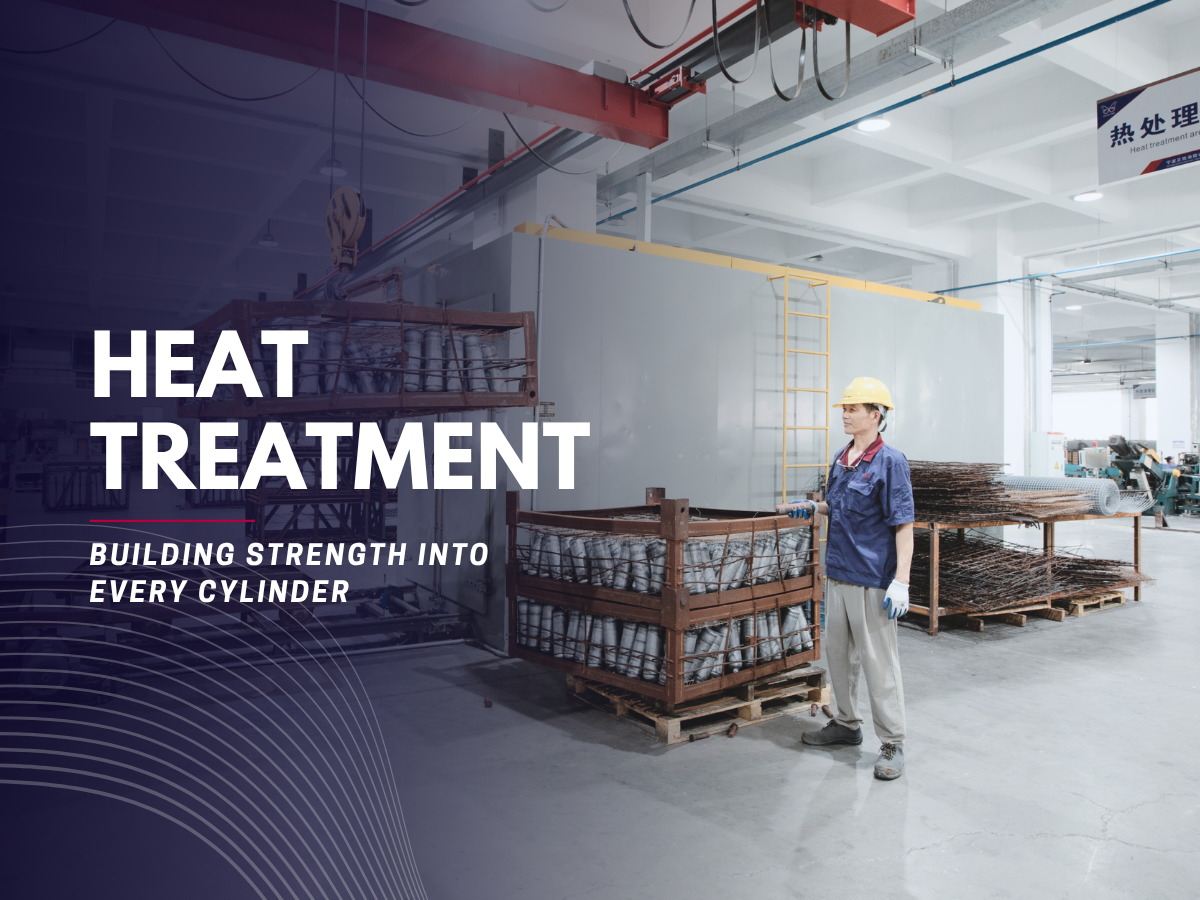
After cold extrusion and necking, the formed cylinder bodies are loaded into a heat treatment furnace according to the production batch. During solution treatment, the cylinders are heated in a controlled furnace and held within the required temperature range for a defined period according to cylinder size, wall thickness, batch loading, and the approved production process.
This process allows the alloying elements in AA6061 aluminum to become more evenly distributed within the aluminum matrix. It helps prepare the material structure for the following artificial aging process and supports the final mechanical performance of the cylinder body.
Artificial aging is the second key stage of heat treatment for AA6061-T6 aluminum cylinders.
After solution treatment, the cylinders are placed into the aging furnace and heated at a lower controlled temperature for a defined period of time. During this process, the aluminum alloy gradually develops the required T6 temper, helping the cylinder achieve stable strength, hardness, and overall mechanical properties.
Artificial aging is not simply a waiting process. It is a controlled strengthening process. The aging temperature, holding time, batch arrangement, and process records are all managed to support consistent results across the production batch.
For high-pressure aluminum cylinders, artificial aging plays an important role in turning the treated aluminum cylinder body into a finished pressure-bearing component. It supports the mechanical performance required for CO₂ cylinders, medical oxygen cylinders, scuba cylinders, industrial gas cylinders, calibration gas cylinders, and other seamless aluminum cylinder applications.
Tensile strength shows how much stress the material can withstand before breaking.
For high-pressure aluminum cylinders, sufficient tensile strength is necessary because the cylinder body must resist internal pressure. Controlled solution treatment and artificial aging help AA6061-T6 aluminum cylinders achieve the required strength level.
Yield strength refers to the point where the material starts to deform permanently.
An aluminum gas cylinder must keep its shape under working pressure and test pressure. Proper heat treatment improves yield strength and helps reduce the risk of permanent deformation during service.
Hardness is an important indicator of material condition after heat treatment.
In aluminum cylinder manufacturing, hardness testing is often used to check whether the cylinder has reached the expected material condition. Stable hardness results also help confirm that the heat treatment process is consistent across the production batch.
Elongation reflects the ductility of the material.
For pressure vessels, strength alone is not enough. The material also needs proper elongation to support safe performance. A well-controlled heat treatment process helps balance strength and ductility, which is important for aluminum cylinders used in high-pressure gas service.
In aluminum cylinder production, heat treatment is a key process because its effect cannot be judged by appearance alone.
A cylinder before and after heat treatment may look similar, but the internal mechanical properties can be very different.
That is why reliable aluminum cylinder manufacturers need strict heat treatment control, including:
· Furnace temperature control
· Process time control
· Batch management
· Heat treatment records
· Hardness testing
· Mechanical property testing
· Traceability from raw material to finished cylinder
In international sourcing, these controls are essential when evaluating aluminum cylinder manufacturing capability. A low-price product without stable process control may create risks in certification, filling, use, and long-term supply.
For aluminum gas cylinders, consistency is as important as individual test results.
A single cylinder passing inspection does not represent full production stability. In mass production, every batch of aluminum cylinders should meet the required mechanical performance.
Stable heat treatment helps ensure consistent performance across the same batch and between different batches. This is especially important for long-term supply, stable filling performance, certification compliance, private-label cylinder projects, and repeated orders for the same cylinder model.
For beverage CO₂ cylinders, medical gas cylinders, scuba cylinders, and industrial gas cylinders, stable batch quality helps reduce risks during filling, assembly, distribution, and end use.
For many aluminum cylinder projects, the first order is only the beginning. A reliable product needs to be produced consistently, tested properly, assembled smoothly, and supplied repeatedly.
That is why manufacturing control matters.
At ZX, our AA6061-T6 seamless aluminum cylinders are produced through a controlled process covering cold extrusion, necking, solution treatment, artificial aging, machining, hydrostatic testing, and final inspection. This allows us to support different aluminum cylinder applications, including beverage CO₂, medical gas, scuba diving, industrial gas, calibration gas, paintball, and customized cylinder projects.
Heat treatment is one of the key steps in this system. It helps the cylinder achieve the required mechanical properties, while later testing and inspection confirm that the finished product is ready for pressure service.
A good aluminum cylinder should not only look clean and well finished. It should also come from a process that can be repeated, checked, and traced.
This is especially important when sourcing high-pressure aluminum gas cylinders for regulated or long-term applications. Product appearance can be copied, but stable process control is much harder to replace.
Before selecting an aluminum cylinder manufacturer, it is important to understand how the supplier controls material, forming, heat treatment, machining, pressure testing, valve compatibility, and batch traceability.
These factors directly affect cylinder strength, safety performance, filling reliability, and supply consistency.
At ZX, we focus on building this reliability into the manufacturing process, so our aluminum cylinders can support customers not only for one shipment, but for long-term product programs.
Heat treatment is not just a heating process. It is a critical manufacturing step that directly affects the mechanical properties of aluminum cylinders.
For AA6061-T6 aluminum cylinders, proper solution treatment and artificial aging help improve tensile strength, yield strength, hardness, elongation, and overall pressure-bearing performance. They also support product consistency, safety, and compliance with applicable cylinder standards.
When evaluating aluminum gas cylinders, the visible surface is only one part of the product. The more important value often comes from the manufacturing control behind it.
A reliable aluminum cylinder starts with reliable process control.


