
A Certificate of Origin is a trade document that identifies the country or region where a product originates. For gas cylinder and valve shipments, it may be requested for customs clearance, tariff preference, a letter of credit or other contractual requirements.
It is important to understand that a Certificate of Origin is not a product approval. A gas cylinder may already comply with DOT, TPED or another technical standard, but a separate origin document may still be required for customs purposes.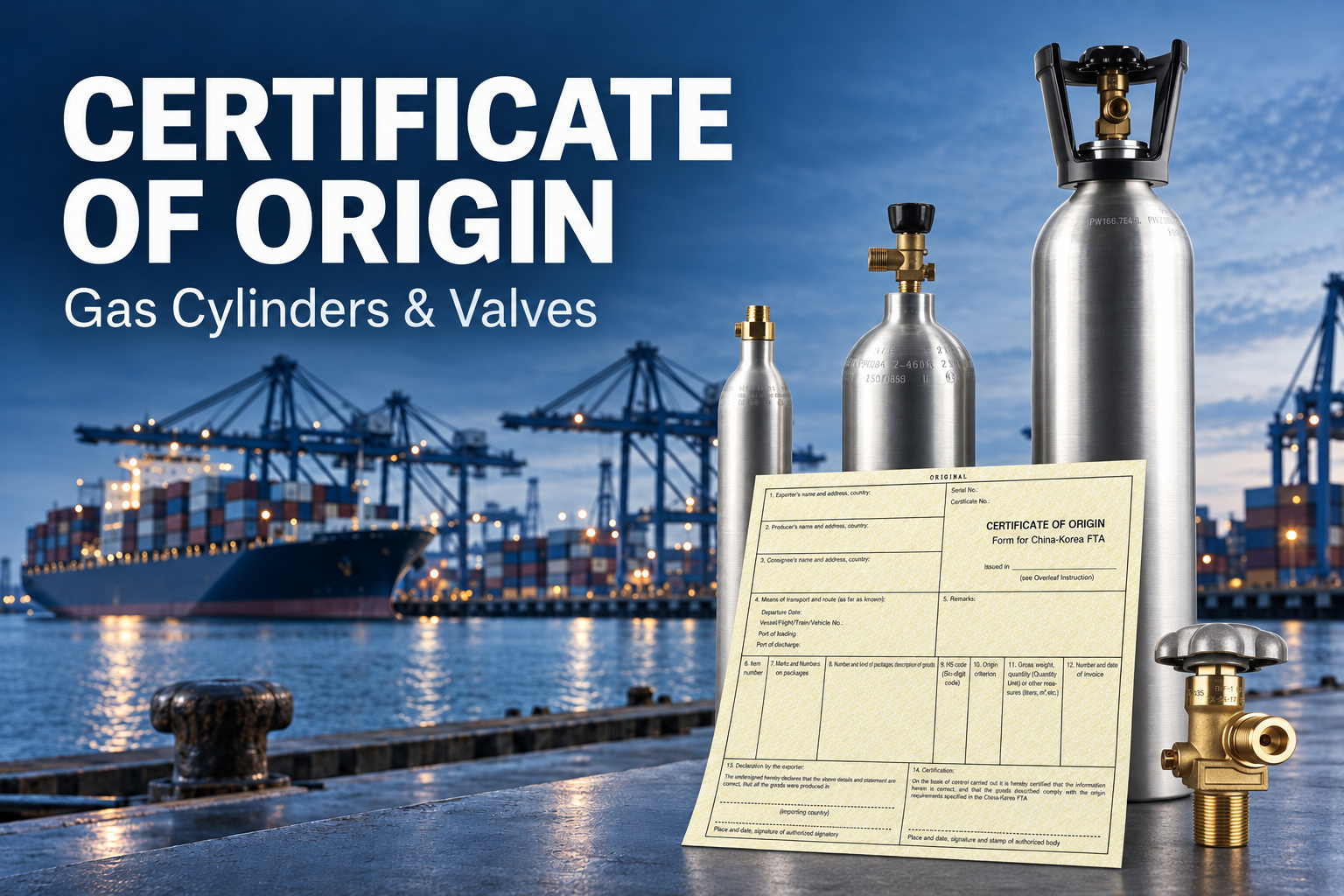
The country of origin is determined under the applicable rules of origin. It is not always the same as the country from which the goods are shipped or the location of the company issuing the commercial invoice.
For manufactured products, origin may be determined by factors such as:
· Where the main manufacturing process takes place
· Whether imported materials have undergone substantial transformation
· Whether the product meets a required change in tariff classification
· Whether a regional value or specific production requirement has been satisfied
The applicable test depends on the importing country and, for preferential treatment, the relevant trade agreement. Therefore, the origin of an aluminium cylinder is not determined only by where its aluminium was produced. The actual cylinder manufacturing process and the applicable product-specific rule must also be considered.
The two main categories of Certificate of Origin serve different purposes.
Type | Main purpose | Possible tariff benefit |
Non-preferential Certificate of Origin | Confirms the general origin of the goods | Normally no |
Preferential Certificate of Origin | Supports a claim under a trade agreement | Yes, if all conditions are met |
A non-preferential certificate may be required for customs control, origin marking, trade statistics, government procurement or other commercial purposes.
A preferential certificate is used when the exporting and importing countries are covered by an applicable trade arrangement. Depending on the destination, this may be referred to as Form E, Form F, an RCEP Certificate of Origin or another form of proof of origin.
Not every product covered by a trade agreement automatically qualifies. The product must meet the relevant origin rule, and the importer must submit the correct proof when claiming preferential treatment.
A Certificate of Origin may be requested when:
· The destination country requires it for customs clearance
· The importer intends to claim a reduced or zero tariff
· It is listed as a required document in a letter of credit
· The sales contract or purchase order specifically requires it
· It is needed for government procurement, registration or internal compliance
A certificate is not mandatory for every international shipment. The importer should confirm the requirement with its customs broker before the goods are shipped.
It is also important to specify the exact document required. Asking only for “a CO” may cause confusion because a general Certificate of Origin cannot necessarily be used to claim preferential duties.
Before the certificate is prepared, the parties should confirm:
· Destination country
· Required certificate type
· Applicable trade agreement
· Product description and HS code
· Exporter, importer and manufacturer details
· Invoice number, quantity, value and packaging information
· Whether an original or electronic document is accepted
The Certificate of Origin should be consistent with the commercial invoice, packing list, bill of lading and customs declaration. The descriptions do not always need to be identical word for word, but there should be no material discrepancy affecting the identification, quantity or declared origin of the goods.
Gas cylinders and valves are often produced by different manufacturers. They may still be included in the same shipment, but the origin of each product must be established separately.
Because cylinders and valves normally have different product descriptions and HS codes, they should be shown as separate items. Supporting manufacturer or production information may also be required.
Whether they can appear on one certificate depends on the exporter, certificate applicant, shipment structure and requirements of the issuing authority.
When products from several suppliers are shipped in one container, the bill of lading may show only one exporter or consolidating company. This does not mean that all products automatically have the same manufacturer or origin.
Depending on the arrangement, each supplier may need to provide its own origin information, or the main exporter may apply using supporting documents from the different manufacturers. In some cases, separate certificates may be more appropriate.
This should be agreed before the customs declaration and bill of lading are finalized.
The exporter shown on the invoice or bill of lading does not always have to be the manufacturer. Trading companies and export agents commonly ship goods manufactured by another company.
However, the manufacturer and production origin must be declared accurately where required. The difference between the exporter and manufacturer should be supported by appropriate commercial and origin documents rather than being concealed or incorrectly described.
Some customs authorities accept electronic certificates or exchange origin data through an online system. Others may still require a paper original.
Even if customs accepts an electronic version, a letter of credit or purchase contract may separately require an original document. The required format should therefore be checked before issuance.
No. DOT and TPED relate to the technical compliance and transport approval of gas cylinders. A Certificate of Origin relates to the economic nationality of the goods. They serve different purposes.
No. The importer must use the correct HS code, the goods must meet the relevant origin rule, and the proof of origin must satisfy the importing country’s requirements. Customs may also request additional supporting documents.
Some certificate systems permit retrospective issuance under specific conditions, but this is not universally available. Preparing the certificate before or around the time of shipment reduces the risk of customs delays and document discrepancies.
A Certificate of Origin is a customs and trade document, not a product approval. The correct document depends on the destination country, HS code, applicable trade agreement and structure of the shipment.
For gas cylinders and valves, particular attention should be paid when the products come from different manufacturers, are consolidated with other suppliers’ goods, or are exported by a company other than the manufacturer. Confirming these details before shipment is the most effective way to prevent inconsistencies and clearance problems.


