
In the world of specialty gases and calibration gases, precise concentration and long-term stability are paramount. Calibration gases are often used to calibrate gas detection instruments and sensors, with concentrations as low as parts per million (ppm) or parts per billion (ppb). In such sensitive applications, even minor chemical reactions or adsorption on valve surfaces can cause calibration fade, compromising instrument accuracy and potentially jeopardizing industrial safety.
C10 valves, commonly fitted to portable calibration gas cylinders, historically relied on nickel-plated brass due to its machinability and cost-effectiveness. However, as the use of highly reactive gases—such as hydrogen sulfide (H₂S), chlorine (Cl₂), and ammonia (NH₃)—has increased, the inherent weaknesses of nickel-plated brass have become apparent. Uneven plating, microscopic porosity, and potential flaking lead to chemical interactions with the gas, causing rapid concentration decay and corrosion-related leaks. Industry practitioners report that once these valves were exposed to ppm-level reactive gases, even minimal brass exposure could compromise the entire cylinder.
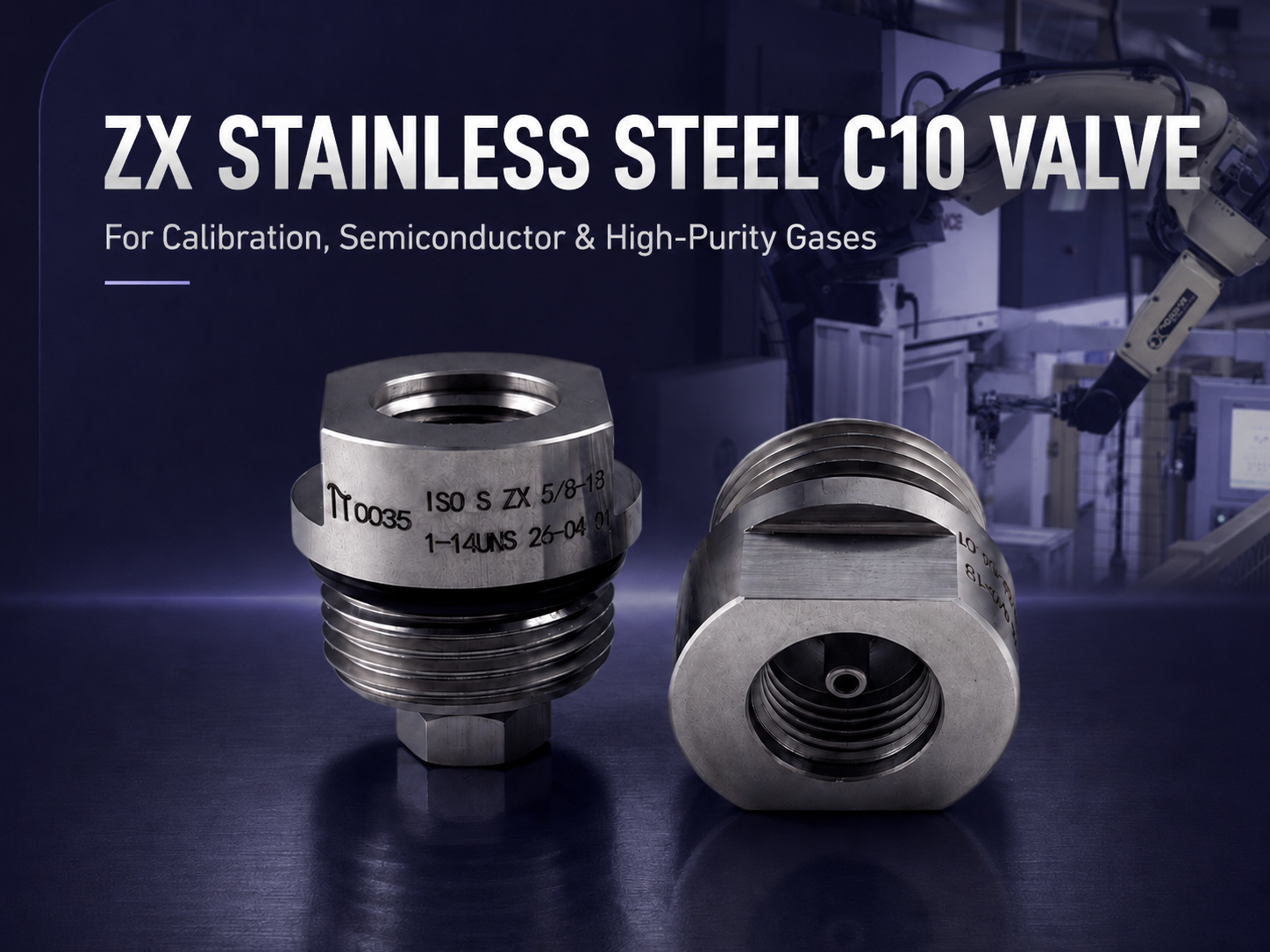
Stainless steel, particularly 316L austenitic stainless steel, provides a solution. Unlike plated brass, its corrosion resistance is inherent in the material. The chromium content forms a dense, self-healing oxide layer that protects the valve from chemical attack, while molybdenum enhances resistance to localized pitting and halogen-induced corrosion. Low carbon content prevents intergranular corrosion after machining, maintaining uniform microstructure and long-term chemical inertness.
The result is a C10 valve that reliably handles H₂S, Cl₂, HCl, NH₃, and other highly reactive specialty gases without risk of concentration decay or leakage. Users who transitioned from nickel-plated brass to stainless steel report virtually zero operational issues, even in highly demanding laboratory and industrial environments.
For manufacturers, laboratories, and calibration centers, stainless steel C10 valves provide the precision, chemical stability, and durability required for modern specialty gas applications. This material evolution represents a critical step in ensuring operational safety and gas integrity.

