
Introduction
Let us get straight to the point. Inside a standard carbon dioxide tank lies immense, volatile pressure. We are talking about upwards of 900 PSI at standard room temperature. Holding back this explosive force relies entirely on a single, highly engineered component. Without this precision gateway, safely containing or dispensing carbon dioxide is physically impossible.
Carbon dioxide is a foundational utility across dozens of distinct sectors. From carbonating craft beer and sustaining aquatic life in planted aquariums to shielding molten welds in heavy manufacturing, this gas is ubiquitous. However, tapping into this compressed resource requires specialized hardware designed specifically to handle its unique chemical and physical properties. Standard plumbing fixtures will fail catastrophically under these conditions.
This comprehensive guide breaks down the core mechanics of these containment mechanisms from a frontline engineering perspective. We will detail the different variations available on the market, explain how forged brass survives extreme stress, and establish the non-negotiable best practices for operating them safely in any industrial or commercial environment.
Key Takeaways
Primary Function: The main flow controller acts as the primary gateway to regulate and safely release high-pressure gas from a storage tank to an external application.
Standard Connections: In North America, specific threading standards dictate that a flat compressible washer is absolutely mandatory to create a leak-proof seal.
Advanced Safety: Spring-loaded variants offer automated functionality by shutting off the gas flow immediately when disconnected. This makes them ideal for quick-release setups.
Built-in Safety Mechanisms: Quality fittings feature integrated burst discs designed to prevent catastrophic tank failures during severe over-pressurization events.
Proper Handling is Crucial: Upright storage, slow actuation, and regular leak checks are strictly required protocols for safe operation.
To truly grasp the mechanics at play, one must first understand how this specific gas behaves under compression. Unlike oxygen or nitrogen, which remain entirely gaseous, carbon dioxide is stored inside the cylinder as a compressed liquid. At a standard room temperature of 70 degrees Fahrenheit, this liquid exerts a vapor pressure of roughly 800 to 900 Pounds per Square Inch.
The primary function of this heavy-duty brass fitting is barrier control. It acts as a controllable wall between that extreme internal pressure and the delicate equipment outside. When you crack open the handwheel, you might hear a sharp hiss. That is the expanding gas at the top of the cylinder escaping at a controlled, manageable rate before it hits the external pressure regulator.
To safely manage this, a heavy-duty CO2 cylinder valve acts as the standardized connection anchor. Because 800 PSI is violently powerful, a regulator must be attached to step the pressure down to a usable 10 or 15 PSI. The brass body provides the secure, precision-machined threading necessary to mount these heavy regulators safely. When completely closed, its job is absolute containment. High-grade internal O-rings prevent ambient leaks of the greenhouse gas into the surrounding environment, ensuring the cylinder remains fully pressurized during long-term storage.
Depending on the geographic region and the operational context, different variations of the core design are utilized to satisfy strict safety requirements. Knowing the difference is critical for facility safety.
In North America, the Compressed Gas Association standardizes gas fittings to prevent the dangerous cross-contamination of incompatible elements. For carbon dioxide, the designated standard is the CGA 320 valve. It features a distinct male thread, specifically 0.825-14 NGO right-hand, alongside a flat nipple face.
Wrenching down a regulator nut onto this fitting without a fresh nylon or Teflon washer is a rookie mistake. It will immediately result in a freezing, high-pressure leak. Unlike fittings used for inert gases, which rely on a metal-to-metal bullnose seal, this specific design cannot form an airtight barrier without that compressible gasket filling the microscopic gaps between the brass surfaces.
For fast-paced environments requiring rapid cylinder swaps, manual handwheels become an operational bottleneck. In these scenarios, a CO2 self closing valve is frequently deployed as the standard upgrade. Operating automatically via an internal spring and pin mechanism, this variant eliminates the need for manual rotation.
When a compatible attachment is firmly connected, it physically depresses the internal pin, allowing the gas to flow freely. The exact moment the attachment is removed, heavy internal spring pressure instantly forces the pathway shut. Consequently, this design virtually eliminates the risk of an operator accidentally leaving a tank open. It is highly valuable in commercial beverage stations and rapid-response industrial setups.
Standard handwheel mechanisms are typically mounted on larger aluminum or steel cylinders ranging from 5lb to 50lb capacities. They provide robust, manual control for permanent installations. In contrast, pin mechanisms are scaled-down versions utilized in highly portable applications. Found on paintball markers, home carbonation canisters, and micro-aquatic kits, they operate similarly to self-closing variants but are engineered for significantly smaller volume outputs.
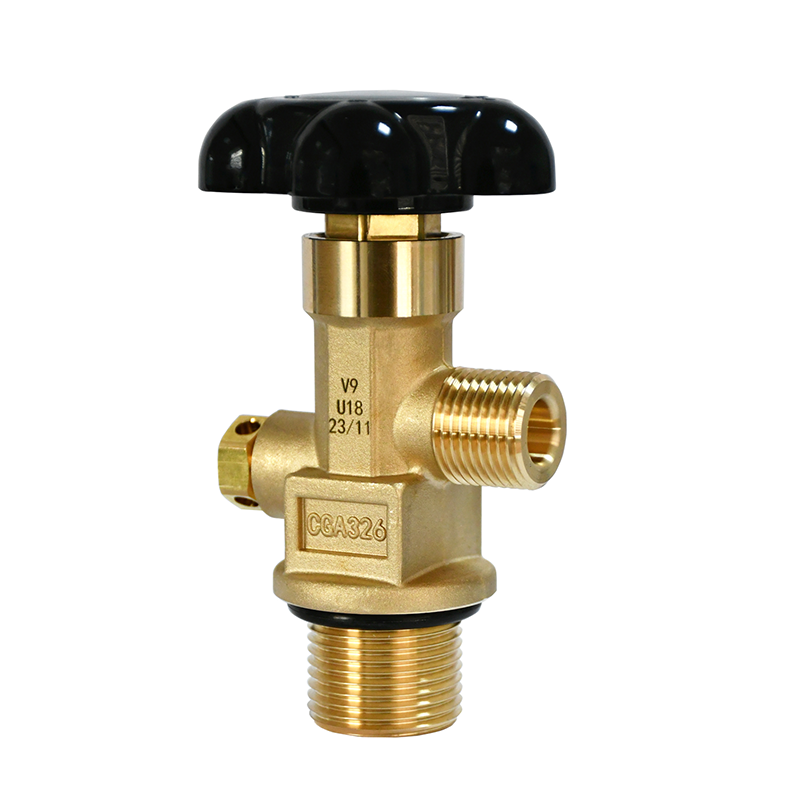
These devices are not simple hollow tubes. They are complex assemblies of precision-engineered parts built to survive freezing temperatures and repetitive mechanical abuse.
The exterior chassis is typically forged from heavy-duty brass or specialized alloys. This dense, non-porous construction is mandatory. As liquid carbon dioxide rapidly expands into gas, it absorbs massive amounts of ambient heat. This drops the temperature of the brass to sub-zero levels. Cast metals fail here because microscopic air pockets crack under extreme cold and 3,000 PSI of internal stress. Forged brass possesses the necessary tensile strength to resist this structural fracturing. The handwheel itself, usually crafted from high-impact aluminum, grants the user the leverage needed to manually actuate the internal stem against high backpressure.
Every compliant fitting is equipped with an ultimate fail-safe known as a burst disc. If a cylinder is accidentally left in a hot vehicle or exposed to a furnace, the internal liquid expands violently. If the internal pressure approaches the structural limits of the aluminum or steel tank, the thin copper burst disc intentionally ruptures at a precise threshold, typically around 21MPa. Instead of the entire cylinder catastrophically exploding like a bomb, the expanding gas is safely vented out the side of the fitting.
While standard configurations release gaseous output from the empty headspace at the top of the tank, certain applications demand liquid output. Fittings equipped with a siphon tube feature a long pipe extending down to the very bottom of the cylinder. It acts exactly like a straw to draw the liquid directly upward. Siphon tubes are strictly necessary for refilling smaller portable tanks or generating rapid freezing effects in theatrical fog machines.
The chemical versatility of this gas means these precision devices are heavily relied upon across a vast array of distinct commercial sectors.
In the hospitality sector, these fittings connect the bulk gas supply to a dual-gauge primary regulator. This setup carefully steps the intense 800 PSI down to a gentle 10 to 15 PSI. This low-pressure output is precisely what is required to carbonate craft beer, kombucha, and soft drinks. Furthermore, it simultaneously pushes the liquid from the keg, through the lines, and out of the draft faucet with unwavering consistency.
Metal Inert Gas welding frequently relies on pure carbon dioxide, or a mixture with Argon, as a shielding gas to protect the molten weld pool from atmospheric oxygen and moisture. Industrial fabrication environments demand heavy-duty, high-flow controllers capable of withstanding dirty, abrasive conditions while delivering a consistent gas flow over long shifts without freezing up.
In recent years, the industrial gas sector has witnessed a significant shift in how flow controllers are manufactured and monitored. As global environmental regulations tighten around greenhouse gas emissions, heavy industries are facing increased scrutiny regarding accidental leaks. Consequently, there is a surging market demand for advanced containment mechanisms equipped with integrated smart sensors.
These modern setups can instantly detect micro-leaks or abnormal pressure drops. They wirelessly alert facility managers via mobile applications before a minor hiss escalates into a costly or hazardous event. In addition, metallurgical advancements have pushed manufacturers to adopt specialized corrosion-resistant alloys, moving beyond traditional forged brass. This evolution significantly extends the operational lifespan of the equipment, reducing maintenance overhead in high-volume applications like commercial brewing and heavy fabrication.
Selecting the correct hardware is a matter of workplace safety, regulatory compliance, and operational efficiency. Abstract concepts do not help on the factory floor. You need hard specifications.
To streamline your procurement process, review the following technical comparison detailing the primary differences between standard and automated systems.
| Specification / Feature | Standard Handwheel Series | Self-Closing Series |
|---|---|---|
| Actuation Method | Manual rotation via aluminum handwheel | Automated internal spring and pin depression |
| Nominal Working Pressure | 15MPa | 15MPa |
| Safety Device Burst Pressure | 21MPa | 21MPa |
| Inlet Thread Standard | PZ27.8 | PZ27.8 |
| Outlet Thread Standard | CGA320 | CGA320 |
| Best Application | Permanent installations, heavy welding, large aquariums | Fast-food beverage stations, rapid cylinder swap environments |
Always prioritize hardware machined from heavy-duty forged brass. Look for integrated O-rings rated for extreme low temperatures, and ensure the product has undergone rigorous hydrostatic testing before reaching the market. The nominal diameter should typically be 4mm to ensure adequate flow without excessive pressure drops.
Even the highest quality forged brass fitting can become a lethal hazard if operated or maintained incorrectly. Adhering to strict safety protocols is mandatory for anyone handling pressurized gases.
To ensure a safe, leak-free connection, operators must follow a methodical procedure. First, visually inspect the threads for any signs of cross-threading, dents, or metal burrs. Next, insert a brand-new nylon or Teflon washer into the regulator nut. Reusing old, crushed washers is the leading cause of micro-leaks. Use a properly sized crescent wrench to tighten the nut securely. Never rely on hand-tightening. Finally, grasp the handwheel and open it extremely slowly. Yanking it open rapidly sends a violent, high-pressure shockwave into the regulator, which can instantly rupture the internal rubber diaphragm.
Because standard configurations are designed to release gas from the headspace, the cylinder must always be stored, transported, and operated in an upright, vertical position. If a standard tank is laid horizontally, liquid covers the internal opening. Opening the handwheel in this state will cause freezing liquid to shoot directly into the regulator. This results in instant destruction of the equipment. Furthermore, cylinders must be secured to a wall with chains and kept away from direct sunlight or radiators to prevent internal pressure spikes.
Regular leak checks should be a routine part of facility maintenance. The most effective method is the soapy water test. Apply a mixture of water and dish soap directly to the stem, the burst disc, and the regulator connection point. If bubbles actively form and expand, a micro-leak is present. Close the tank and tighten the connections.
If a mechanism freezes completely open due to a massive, rapid discharge of gas, do not attempt to stop the flow. The expanding gas will drop the temperature of the brass to dangerous sub-zero levels, causing severe frostbite if touched with bare hands. Instead, evacuate and ventilate the area immediately, allowing the cylinder to safely empty itself.
The primary difference lies in the specific gas they are engineered to regulate and their sealing mechanisms. The 320 standard is designed specifically for carbon dioxide and features a flat nipple design that strictly requires a separate compressible washer to form an airtight seal. In contrast, the 580 standard is used for high-pressure inert gases like Argon, Helium, and Nitrogen. It utilizes a rounded, metal-to-metal bullnose connection that seals itself through mechanical torque without the need for any external washers.
Yes. If you are connecting equipment to a standard North American setup, inserting a nylon, Teflon, or fiber washer is absolutely mandatory. Because the brass surfaces of the fitting and the regulator are perfectly flat, they cannot form an airtight seal on their own. The washer acts as a vital gasket, compressing to fill microscopic scratches and gaps to prevent high-pressure gas from escaping.
Yes, but it cannot be refilled using standard gravity or basic pressure-transfer methods alone. Refilling these automated variants requires a specific commercial filling adapter. This specialized adapter physically depresses the internal pin, holding the pathway open to allow liquid to be pumped backward from the master supply tank into the smaller cylinder during the filling process.
This phenomenon is caused by the Joule-Thomson effect. When highly pressurized liquid passes through the narrow restriction of the fitting and rapidly expands into a gas, it absorbs a massive amount of ambient heat from its surroundings. This rapid heat absorption causes the brass and the attached regulator to drop in temperature, leading to condensation and thick frost buildup. While slight frosting is normal during heavy use, a completely frozen solid fitting indicates that your flow rate is dangerously high and should be reduced immediately.
With proper care, gentle handling, and protection from environmental debris, a high-quality forged brass flow controller can function safely for decades. However, regulatory bodies require the aluminum or steel cylinder itself to undergo hydrostatic structural testing every 5 years. During this mandatory inspection, the brass fitting is removed, thoroughly inspected, cleaned, and often rebuilt with fresh internal O-rings. If the exterior threads are worn or the internal stem is bent, the entire unit must be fully replaced.
Absolutely not. Threading standards and pressure ratings are strictly gas-specific to prevent catastrophic mixing. Attempting to force a carbon dioxide fitting onto an oxygen cylinder, or vice versa, bypasses critical safety designs and can lead to immediate explosions or severe equipment damage.
The connection should be snug and firmly tightened with a properly sized crescent wrench. However, you must not overtighten it to the point where you completely crush or shred the nylon washer inside. A firm quarter-turn past hand-tight is usually sufficient to create a flawless seal.
Conclusion
The primary flow controller on a high-pressure tank is far more than a simple on and off switch. It is a highly engineered piece of safety equipment essential for managing immense, volatile pressure. Understanding the mechanics of these components is absolutely vital for operational efficiency and workplace safety on the factory floor.
Whether your specific application requires a standard manual handwheel for heavy industrial welding or an advanced, automated variant for a high-volume commercial beverage station, knowing the exact technical differences ensures you select the right tool for the job. Do not compromise on containment safety. For facility managers and engineers looking to upgrade their hardware, always prioritize certified forged brass components. Explore the full range of high-performance, rigorously tested containment solutions at ZXHP Gas to ensure your operations remain safe, compliant, and efficient.


