
Standardizing gas delivery in a hospital environment requires a delicate balance. We must align strict clinical demands with facility logistics, safety compliance, and procurement efficiency. While bulk liquid oxygen systems handle primary supply, high-pressure equipment remains critical. You need a reliable medical cylinder fleet for patient transport, system backups, and specialized gas delivery. The right selection strategy prevents hazardous clinical delays. It also reduces manual handling injuries among your medical staff. Making informed choices directly impacts patient care quality.
This guide establishes a clear framework for evaluating and selecting the optimal mix of cylinder types. You will learn how to match specific gas applications with proper sizing standards and material specifications. We will explore advanced valve technologies, ergonomic considerations, and essential safety mechanisms. Finally, we provide actionable steps to ensure regulatory compliance and proper storage across your entire facility.
Selecting the correct medical cylinder involves evaluating material weight, MRI compatibility, and integrated valve technology against specific departmental needs.
Standardization of cylinder sizes (e.g., E-cylinders for transport) reduces training overhead and minimizes connection errors.
Compliance with regional color-coding and international safety standards (e.g., EIGA, NFPA 99) is non-negotiable for facility accreditation.
Clinical needs dictate gas requirements. Your facility must match physical equipment to specific patient therapies. We separate these categories by their core applications.
Oxygen provides primary life support. Clinicians rely on it for resuscitation. It forms the foundation of anesthesia mixtures. Every hospital department consumes oxygen daily.
Identification remains strictly regulated. In the United States, NFPA standards require green coloring. International ISO standards mandate white. Misidentifying this gas causes fatal patient outcomes. Always verify the label before connection.
You face the highest volume requirement here. Procurement teams must secure portable units. They also need large-format backup units. A reliable medical cylinder network ensures continuous patient care.
Nitrous oxide provides essential analgesic effects. Surgical teams rely on it heavily for anesthesia. Dental and obstetric departments also use it frequently. US standards require a blue color designation for N2O.
Medical air serves a different but equally critical purpose. It drives pneumatic mechanical ventilators. It also regulates humidity in neonatal incubators. US standards assign yellow to medical air. ISO standards use a black and white color scheme. Contaminating medical air lines causes severe patient harm. Always verify the source purity before clinical application.
Carbon dioxide plays a specialized surgical role. Surgeons use it for insufflation during laparoscopy. It expands the abdominal cavity safely. This creates necessary visibility for surgical instruments. CO2 also stimulates respiratory centers in specific treatments.
You identify CO2 by its gray color. Specialty mixtures serve diagnostic and laboratory functions. Technicians use them for blood gas analyzer calibrations. These mixtures require distinct regulatory tracking. Procurement often involves highly specific regulator attachments. This prevents accidental connection to patient breathing circuits.
| Gas Type | Primary Clinical Use | US Color Code (NFPA) | ISO Color Code |
|---|---|---|---|
| Medical Oxygen | Life support, resuscitation | Green | White |
| Nitrous Oxide | Analgesic, anesthesia | Blue | Blue |
| Medical Air | Ventilator driving, incubators | Yellow | Black & White |
| Carbon Dioxide | Surgical insufflation | Gray | Gray |
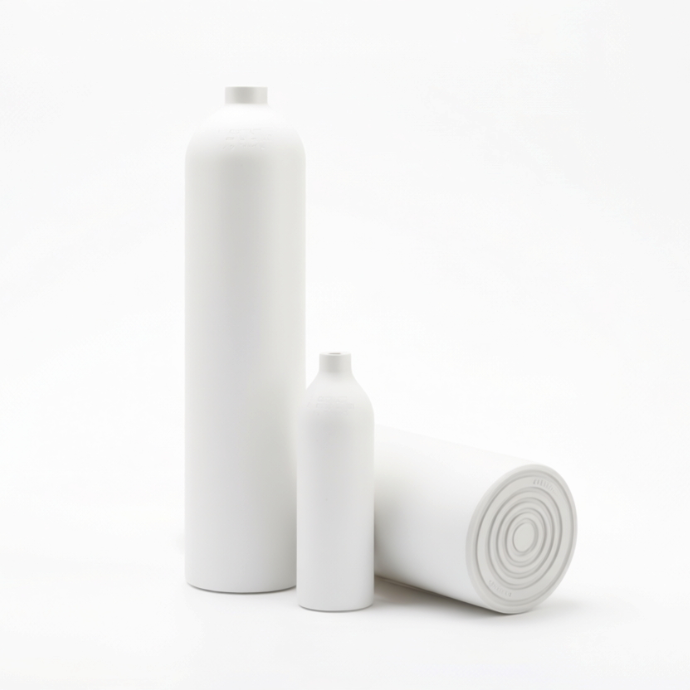
Proper sizing translates technical dimensions into operational success. Facility managers must deploy the right size to the right department.
Ambulatory care demands lightweight portability. Emergency crash carts require immediate gas access. E-cylinders serve as the universal hospital standard here. An E-size unit holds approximately 680 liters of oxygen. This capacity provides sufficient transport time between wards.
Material choice heavily impacts staff safety. Aluminum dominates the portable market. It reduces overall tare weight significantly. Lighter weights minimize staff lifting injuries. Nurses transport these units constantly. Heavy steel units would cause severe ergonomic strain. Choosing an aluminum medical cylinder improves daily workflow.
Stationary applications demand massive gas volumes. Operating rooms consume gas at rapid rates. Manifold system backups protect the entire hospital infrastructure. H-cylinders answer this high-volume need. A standard H-size unit yields approximately 6,900 liters of oxygen.
These units rarely move once installed. Heavy-duty steel serves as the standard material here. Steel provides exceptional durability. It withstands higher internal pressures safely. You chain these securely to the wall. They act as the ultimate safety net during power failures.
Magnetic Resonance Imaging creates unique hazards. Zone 3 and Zone 4 MRI suites house powerful magnets. Standard steel equipment turns into lethal projectiles. You cannot bring traditional equipment near the scanner.
Staff must use strictly non-magnetic materials. Manufacturers build these from specialized aluminum alloys. They also install non-ferrous brass or aluminum valves. Evaluation criteria require strict visual indicators. You will usually see prominent MRI Safe labeling. Missing these labels violates safety protocols. A single mistake causes catastrophic equipment damage and patient injury.
Selecting suppliers requires a features-to-outcomes approach. You must evaluate the integrated technology carefully.
Traditional valves represent the older industry standard. They require clinicians to attach separate external regulators. This presents several operational challenges. Regulators get lost in busy supply rooms. Threading wear degrades the connection over time.
VIPRs change this dynamic completely. VIPRs feature built-in pressure regulators and flow meters. You simply turn a dial to initiate gas flow. This drastically reduces emergency setup time. VIPRs minimize regulator maintenance overhead significantly. They remove the frantic search for missing attachments.
Connection errors lead to fatal clinical outcomes. The Pin Index Safety System (PISS) prevents these tragedies. PISS applies primarily to portable equipment sizes. The valve yoke features specific pin placements. Oxygen always uses pins in positions 2 and 5. You physically cannot attach a nitrous oxide regulator.
This mechanical safeguard is essential for facility accreditation. Large backup units use the Diameter Index Safety System (DISS). DISS relies on varying thread diameters. Both systems guarantee connection integrity across your facility.
Handling high-pressure gas requires physical exertion. Ergonomics must guide your procurement decisions. You must assess handle designs on every unit. Poor handles cause hand fatigue and drops. Protective valve shrouds shield the most vulnerable component.
A sheared valve turns the unit into a high-speed hazard. Evaluate the total tare weight carefully. Facility managers review these against internal ergonomic policies. Staff safety directly impacts operational efficiency. Use these criteria when evaluating your suppliers:
Assess the integrated carrying handles for grip comfort.
Check the durability of protective valve shrouds under impact.
Verify the total tare weight against maximum lifting limits.
Compliance ensures facility safety and prevents audit failures. Authoritative knowledge of risk mitigation saves lives.
High-pressure containment stresses the metal structure constantly. Regulatory bodies mandate regular safety inspections. The DOT and EIGA enforce strict hydrostatic testing intervals. Testing usually occurs every five to ten years. The interval depends on the material composition.
Technicians submerge the unit in water. They pressurize it to measure structural expansion. Failing units undergo immediate condemnation. Purchasing cheap, low-quality materials introduces significant risk. They often degrade early and fail initial hydrostatic testing. This forces premature replacement cycles.
Storage rooms must meet stringent safety codes. NFPA 99 outlines the definitive facility requirements. You must separate full units from empty ones clearly. Confusion here delays emergency clinical responses. Securing high-pressure units remains a critical priority.
Unsecured units tip over easily. Tipping shears off the top valve. This releases pressure instantly and creates physical hazards. Follow these steps to ensure proper storage compliance:
Separate full and empty inventory using distinct physical zones.
Secure all upright units firmly with heavy-duty chains.
Position chains at the top and bottom thirds of the unit.
Maintain clear ventilation pathways in all storage closets.
Medical gases classify as prescription drugs. The FDA and equivalent global bodies regulate them strictly. Facilities must maintain comprehensive batch records. You must track every unit entering your hospital.
Serialized tracking links specific units to patient interventions. Barcode integration speeds up this mandatory logging. Many hospitals now deploy RFID technology. RFID readers locate lost inventory instantly. This prevents unapproved units from reaching clinical floors. Traceability protects patients from expired or contaminated gas.
Choosing the right high-pressure equipment goes beyond basic commodities. It dictates critical clinical response times. It ensures staff safety during rapid patient transports. It also guarantees your facility passes stringent accreditation audits.
Hospitals should prioritize strict standardization. You must minimize the variance in sizes and valve types. Fewer variations reduce staff training overhead. They also lower the risk of connection errors. Facilities should actively transition toward integrated valve technologies. VIPRs excel in high-stress transport scenarios. They remove complex mechanical steps during emergencies.
Take immediate action before engaging new suppliers. Conduct a localized audit of lost E-cylinders today. Assess the current age of your stationary H-cylinder backups. Review their next scheduled hydrostatic testing dates. Clear data drives better procurement decisions.
A: An E-cylinder is a lightweight, portable aluminum unit holding roughly 680 liters of gas. Staff use it for ambulatory care and patient transport. An H-cylinder is a massive, stationary steel unit holding about 6,900 liters. Facilities chain H-cylinders to walls to provide high-volume backup for manifold systems.
A: Regulatory bodies like the DOT and EIGA require hydrostatic testing every 5 to 10 years, depending on the material. If a unit fails this expansion test, it is permanently condemned. Aluminum units typically last for decades if they continuously pass hydrostatic testing and avoid physical damage.
A: Strictly no. MRI rooms use powerful magnetic fields that turn standard steel equipment into lethal projectiles. Facilities must use specialized, non-magnetic aluminum units equipped with non-ferrous valves. These must feature prominent visual indicators and explicit MRI Safe labeling before entering Zone 3 or 4 suites.
A: The Pin Index Safety System is a vital mechanical safeguard used on portable gas valves. It features specific pin hole configurations assigned to different gases. For example, oxygen uses positions 2 and 5. This prevents a clinician from accidentally attaching a nitrous oxide regulator to an oxygen supply.

