
A CO₂ Cylinder is much more than a simple storage vessel. It stands as a highly regulated, mission-critical asset ensuring continuous operations across industrial and commercial landscapes. Without reliable high-pressure storage, entire production lines, research labs, and hospitality businesses can grind to an abrupt halt.
The hidden costs of improper cylinder selection run deep. Choosing the wrong vessel can trigger severe operational downtime and costly gas contamination. Even worse, ignoring pressure vessel compliance exposes businesses to severe safety hazards and heavy regulatory fines. You cannot afford to treat these vessels as an afterthought.
This guide provides a concrete framework for evaluating and safely managing your high-pressure gas storage. You will learn how to match purity grades to specific needs and navigate complex safety standards. Ultimately, we will help you select the exact cylinder required for your operational demands.
Selecting a CO₂ cylinder requires matching gas purity grades (industrial, medical, food-grade) with specific application standards.
Cylinder material (steel vs. aluminum) directly impacts portability, durability, and commercial suitability.
Strict adherence to pressure vessel compliance (e.g., hydrostatic testing, proper CGA valving) is non-negotiable for workplace safety.
Evaluating a supplier involves looking beyond gas price to assess delivery reliability, cylinder maintenance history, and purity certifications.
Managing high-pressure gas involves strategic decision-making. Standardizing your approach to gas storage prevents unexpected interruptions and protects your bottom line. We must view these vessels as active components of your supply chain.
Standardizing cylinder sizes based on daily consumption rates prevents bottlenecking. If a manufacturing plant relies on undersized tanks for heavy continuous welding, operators waste valuable hours swapping out equipment. By tracking exact gas flow rates, you can deploy the correct vessel capacities. This proactive approach ensures supply run-outs never disrupt your operational rhythm.
Utilizing degraded or non-compliant high-pressure vessels carries massive legal and financial implications. A ruptured tank or a leaking valve can cause immediate workplace injuries. Local safety authorities routinely inspect storage facilities. If they discover outdated inspection stamps or improper storage chains, they levy substantial fines. Protecting your workforce means strictly adhering to safety regulations and eliminating compromised equipment immediately.
Evaluating the financial side of gas storage requires comparing purchasing against leasing models. When you purchase a cylinder, you assume all maintenance overhead. You must pay for mandatory hydrostatic testing, valve replacements, and internal cleaning. Leasing shifts this testing and maintenance burden to the supplier. Evaluating these two avenues helps you identify the most cost-effective strategy for your specific business volume.
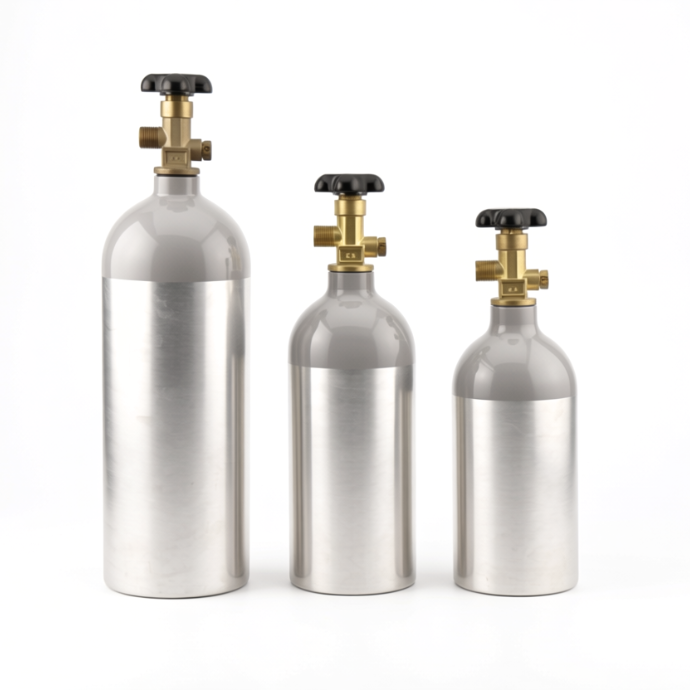
Different industries demand vastly different gas specifications. You must align your cylinder choices with strict performance criteria to guarantee end-product quality.
In metal fabrication, carbon dioxide acts as a crucial active shielding gas. It protects the weld pool from atmospheric contamination, ensuring deep penetration and strong joints.
This environment requires heavy-duty steel cylinders capable of sustaining high flow rates. Steel offers the immense durability needed to survive rough factory floors.
Best Practice: Secure heavy steel cylinders to a fixed wall rack or specialized welding cart to prevent tipping.
Common Mistake: Using undersized tanks for automated robotic welding, leading to frequent, costly line stoppages.
The food industry relies on carbon dioxide for carbonation, Modified Atmosphere Packaging (MAP), and pH control.
You face a strict requirement here: you must use food-grade gas (typically 99.9% purity). The CO₂ Cylinder must undergo rigorous internal sanitation. This prevents any residual hydrocarbons or rust from causing flavor contamination. A single contaminated tank can ruin an entire production batch.
Medical and research facilities use this gas for incubator atmosphere control and specialized cryotherapy procedures. Cell cultures require exact environmental conditions to thrive.
These operations demand ultra-high purity gas. Aluminum cylinders are standard here because they prevent internal oxidation. Steel can rust if moisture enters the tank, but aluminum remains pristine. You also need specialized flow-control valves to deliver precise micro-liters of gas.
| Industry | Primary Role | Purity Requirement | Preferred Material |
|---|---|---|---|
| Manufacturing (Welding) | Shielding Gas | Industrial Grade (99.5%) | Steel |
| Food & Beverage | Carbonation / MAP | Food Grade (99.9%) | Aluminum / Treated Steel |
| Medical & Lab | Incubators / Cryotherapy | Ultra-High Purity (99.99%+) | Aluminum |
Beyond heavy industry, carbon dioxide drives countless everyday commercial applications. Sizing your equipment correctly dictates how smoothly your daily operations run.
Restaurants and bars require continuous carbonation for draft beer and soda systems.
These businesses constantly balance space constraints against refill frequency. A small venue might lack the footprint for bulk storage. Therefore, 5lb to 20lb aluminum cylinders represent the industry standard. Aluminum provides excellent portability for staff swapping out tanks in cramped basements. Furthermore, aluminum resists external corrosion in damp, refrigerated environments.
Indoor farming utilizes enriched carbon dioxide to enhance plant photosynthesis, boosting crop yields. Similarly, high-end planted aquariums inject gas into the water to feed aquatic flora.
These setups require highly automated regulator compatibility. Plants and aquariums demand consistent, extremely low-flow delivery. A sudden pressure spike can instantly kill aquatic life. Precise needle valves and electronic solenoids ensure safe, metered dosing.
Many facilities use specialized suppression systems and portable extinguishers to fight electrical fires safely.
These emergency devices rely on rapid-discharge valves. Unlike continuous flow applications, fire suppression requires dumping massive amounts of gas instantly to choke out oxygen. Because the internal pressure remains constant as long as liquid remains, you cannot rely on a pressure gauge to check capacity. You must implement rigorous weight-checking schedules to ensure emergency readiness.
Calculate your estimated weekly gas volume consumption.
Measure the physical dimensions of your storage area.
Determine the weight limitations for your staff handling the equipment.
Select a cylinder size balancing minimum swap frequency against safe handling weights.
Handling pressurized gas demands intense respect for physics and strict regulatory compliance. Negligence here leads to catastrophic consequences.
Carbon dioxide exists inside the vessel in a unique state. It is both a liquid and a gas. The liquid sits at the bottom, while the gas fills the headspace. Because of this phase equilibrium, the pressure gauge will read roughly 800 PSI at room temperature until all the liquid boils off.
You must store every CO₂ Cylinder vertically. Storing them horizontally risks sending freezing liquid through the regulator, causing instant mechanical failure. You must chain them securely to a wall. Additionally, strict temperature control prevents ambient heat from causing dangerous over-pressurization.
Carbon dioxide is heavier than air. It pools in low-lying, poorly ventilated areas like brewery basements. This creates a severe asphyxiation risk. You cannot smell or see it.
OSHA and local safety standards mandate ambient gas monitors in confined storage areas. These monitors trigger alarms before concentrations reach lethal levels.
| Concentration (PPM) | Health Impact / Regulatory Standard |
|---|---|
| 400 - 1,000 | Normal outdoor/indoor ambient air. |
| 5,000 | OSHA Permissible Exposure Limit (8-hour shift). |
| 30,000 | Immediate danger to life. Causes dizziness and increased heart rate. |
| 100,000+ | Loss of consciousness and fatal asphyxiation within minutes. |
Metals fatigue over time when subjected to high pressure. Regulatory agencies require requalifying most cylinders every five years through hydrostatic testing.
During this test, technicians fill the tank with water and pressurize it beyond its normal limits to measure structural expansion. If it expands too much, it fails and is destroyed. Instruct your buyers and receiving staff to always verify the stamped inspection dates on the crown upon delivery. Never accept an expired tank.
Building a reliable gas supply architecture requires careful evaluation of materials, hardware, and supplier capabilities. Use this framework to finalize your strategy.
Your choice between steel and aluminum dictates daily operations.
Steel: Offers massive volume capacity and extreme durability. However, it is incredibly heavy. Steel is also prone to internal rust if exposed to moisture, making it less ideal for high-purity medical or food uses unless specially treated.
Aluminum: Much lighter and highly corrosion-resistant. It serves as the superior choice for food, medical, and damp commercial environments. The trade-off is a lower total gas capacity compared to industrial steel equivalents.
A mismatch between your cylinder valve and your equipment regulator causes dangerous leaks. In North America, the CGA-320 valve represents the standard for this specific gas. You must detail the importance of matching this hardware exactly. Using cheap adapters or forcing incorrect threads destroys the brass fittings and creates a severe blowout hazard.
Selecting a supplier involves much more than finding the lowest price per cubic foot. You are entering a partnership for safety and reliability. Ask these critical questions:
Do they provide verifiable gas purity certificates for every batch?
What is their specific cylinder tracking and internal maintenance protocol?
Do they offer scalable swap-out schedules based on your seasonal demand fluctuations?
A reputable vendor will transparently share their hydrostatic testing schedules and cleaning procedures.
Securing the right high-pressure gas solution directly optimizes your production yield, ensures strict safety compliance, and protects the quality of your end product. Treating these vessels as critical infrastructure rather than simple consumables pays dividends in long-term reliability.
Next Steps:
Audit your current daily gas consumption rates to identify sizing inefficiencies.
Walk your facility to physically review all existing inspection stamp dates on your equipment.
Consult an experienced, certified gas supplier to re-architect your deployment strategy based on purity and flow needs.
A: Food-grade gas achieves a higher purity percentage (usually 99.9%) and undergoes a rigorous purging process. This process ensures the complete absence of harmful benzene, ammonia, and hydrocarbon impurities. Industrial-grade gas may contain trace contaminants that do not affect welding but would severely taint the flavor and safety of beverages.
A: Industry regulations standardly require a hydrostatic test every five years. You can verify this by reading the crown stamp on the vessel. It displays a month, the tester’s ID symbol, and the year. Do not use or refill a vessel if the date has expired.
A: The vessel contains both liquid and gas phases in equilibrium. As room temperature rises, some liquid boils into gas, increasing the internal pressure. If the temperature drops, gas condenses back into liquid, lowering the pressure reading. This physical relationship means gauges reflect temperature, not remaining capacity.
A: Yes, you can use aluminum for welding, but it is rarely practical. Aluminum vessels generally hold less volume than large steel tanks, requiring frustratingly frequent swap-outs during long welding shifts. Additionally, aluminum shows wear-and-tear much faster in rough, heavy-duty industrial environments compared to robust steel.

