
The thread connecting a valve to a gas cylinder may look like a small detail, but it plays a critical role in the safety and gas tightness of the complete assembly.
Gas cylinder valve inlet threads are generally divided into two types: parallel threads and tapered threads. Both can provide a safe and reliable connection, but they work, seal and are inspected in different ways.
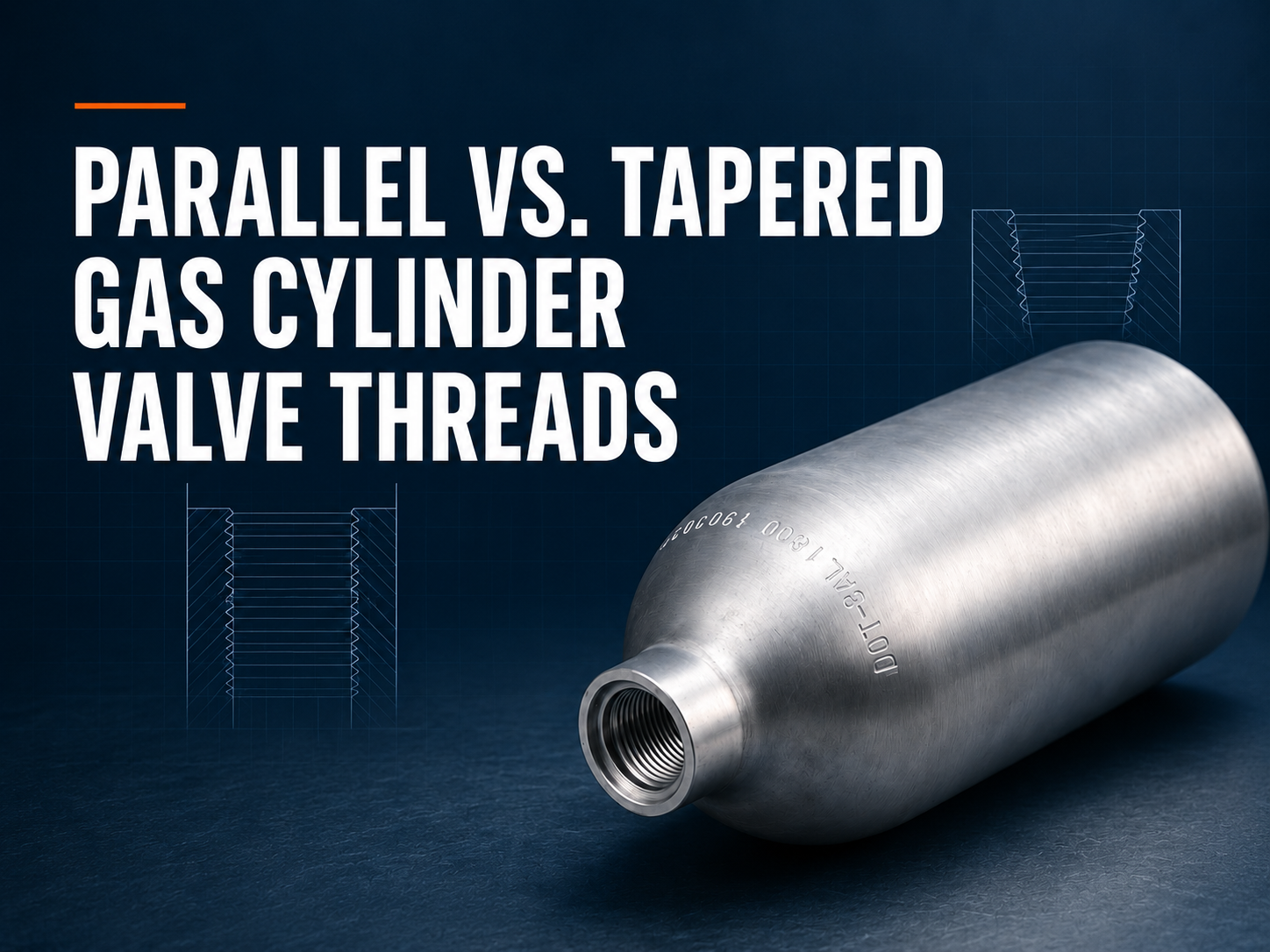
A parallel thread, also called a straight thread, maintains essentially the same diameter throughout its threaded length.
Its structure is similar to a conventional bolt entering a nut: the thread provides the mechanical connection, but gas tightness is normally achieved by an O-ring, gasket or specially designed sealing surface.
In simple terms:
The thread holds the valve; the sealing element keeps the gas inside.
Because the thread does not become progressively tighter, the final valve position is usually controlled by a shoulder or sealing surface. This arrangement is widely used on aluminum cylinders and can provide predictable valve positioning and repeatable assembly.
Common parallel cylinder threads include M18 × 1.5, M25 × 2, 0.750-16 UNF and 1.125-12 UNF.
A tapered thread gradually changes in diameter. As the valve is screwed into the cylinder neck, the internal and external threads engage more tightly.
The principle is similar to inserting a tapered cork into a bottle: the deeper it enters, the tighter the fit becomes.
Common tapered cylinder threads include 17E, 25E and NGT.
This progressive engagement creates a compact and strong mechanical connection. However, microscopic gaps can still remain between the thread surfaces. An approved sealing material is therefore normally used according to the connection design and gas service.
Thread selection is influenced by cylinder material, application, regulations and the existing filling and maintenance infrastructure.
17E and 25E tapered connections have a long-established presence in the European industrial gas market. Filling plants, valve suppliers and cylinder inspection companies already have compatible tools, gauges and procedures for these connections.
Many American aluminum cylinders use parallel UN or UNF threads. U.S. transportation regulations also require DOT-specification aluminum cylinders in oxygen service to have straight-threaded openings.
These are market tendencies rather than absolute geographical rules. Europe also uses parallel connections such as M25 × 2, while American steel industrial cylinders commonly use tapered NGT threads. The general DOT-3AL specification can also accommodate straight or tapered threads when the relevant requirements are met.
The sealing method depends on where the connection is designed to seal.
Parallel-thread connections normally seal at an O-ring, gasket or defined sealing surface. Applying tape to the thread is therefore usually unnecessary unless it is specifically required by the approved design.
Tapered threads may use PTFE tape or an approved liquid or paste thread sealant to fill the small gaps between mating threads and prevent gas from following the spiral thread path.
The material that looks like “glue” is normally a specialized thread sealant, not an ordinary adhesive. Some products cure between metal surfaces, while others remain soft.
Tape and liquid sealant should not be exchanged simply according to personal preference. They can change thread friction and affect how deeply the valve enters the cylinder at a given torque. The material must also be compatible with the gas, especially in oxygen, high-purity and specialty-gas applications.
The difference between plug gauges and ring gauges is easy to remember:
· A plug gauge enters the cylinder neck to inspect the internal thread.
· A ring gauge fits around the valve inlet to inspect the external thread.
A plug gauge is like a test key entering a lock, while a ring gauge is placed around the valve thread like a ring around a finger.
Parallel threads commonly use GO and NO-GO gauges. Tapered threads are generally inspected by checking where the tapered gauge stops relative to a specified reference or limit.
The gauge must match the complete thread designation. A gauge that is “almost correct” is still incorrect—just as a key that enters halfway cannot be considered the right key.
The nominal diameter alone cannot confirm compatibility.
For example, 25E and M25 × 2 both contain the number “25,” but they are not interchangeable:
· 25E is a tapered thread.
· M25 × 2 is a parallel thread.
· Their geometry and sealing arrangements are different.
· They require different inspection gauges.
It is similar to two shoes having the same marked size but completely different shapes: the number looks right, but the fit is not.
The complete thread designation should always be confirmed from the approved cylinder drawing, valve drawing or applicable standard.
Parallel and tapered threads use different connection and sealing principles. However, when designed, manufactured and installed according to the applicable requirements, both can provide a safe and reliable gas cylinder valve connection.
The key is not to decide which thread is universally “better,” but to ensure that the cylinder and valve have exactly matching thread specifications, sealing arrangements and installation requirements. A similar nominal diameter—or even a valve that can be partially screwed in—does not prove compatibility.
When selecting a cylinder valve, the complete thread designation should therefore be confirmed rather than relying on diameter alone. For customized projects, the sealing material, installation torque and plug- and ring-gauge requirements should also be agreed before production.
ZX can assist customers in confirming an appropriate valve connection and inspection solution based on the cylinder standard, gas service, working pressure and destination market.


