
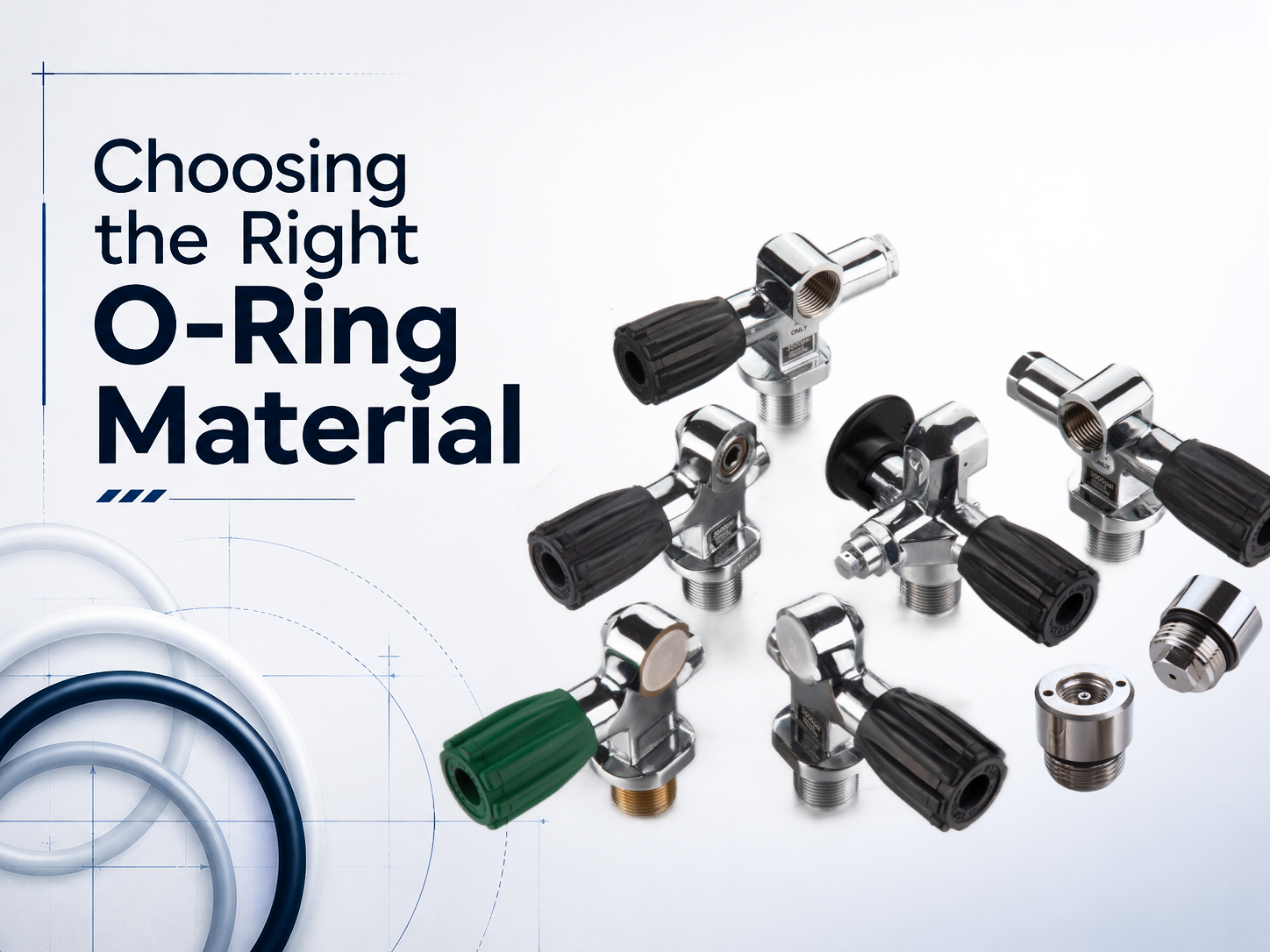
In a gas cylinder valve, the O-ring is a small but important sealing component. It helps the valve maintain sealing performance under pressure and supports safe gas storage, filling and discharge.
For high-pressure gas cylinder valves, even a small sealing component can affect leakage performance, service life and overall valve reliability. This is especially important for CO₂ cylinder valves, oxygen cylinder valves, medical oxygen valves and industrial gas cylinder valves.
Although O-rings may look similar, different elastomer materials perform very differently. If the material is not suitable for the gas medium or operating conditions, the O-ring may swell, harden, crack or lose elasticity, which can lead to leakage or reduced service life.
For gas cylinder valves, O-ring selection should be based on several factors, including gas type, working pressure, operating temperature, valve structure, sealing position and chemical compatibility.
Gas cylinder valves are used with many different gases, such as CO₂, oxygen, nitrogen, argon and special industrial gases.
Different gases have different compatibility requirements. Some applications require good aging resistance and low leakage performance, while others may require oxygen compatibility, high-purity gas cleanliness or resistance to higher operating temperatures.
For this reason, there is no single O-ring material that is suitable for every cylinder valve. The correct material must be selected according to the actual gas medium and working conditions.
NBR, also known as nitrile rubber, is one of the most commonly used elastomer materials in industrial sealing applications.
It offers good wear resistance and stable sealing performance in many general gas applications. NBR is also relatively economical, which makes it a practical choice for many standard gas cylinder valve sealing positions.
NBR is often selected for standard industrial gas valve applications where the working conditions are not extremely demanding. However, compatibility should always be confirmed according to the actual gas medium, pressure and temperature.
EPDM is known for its good aging resistance, ozone resistance and weathering resistance. In gas cylinder valves, EPDM can be used in certain gas applications where the medium is compatible with EPDM and does not contain oil-based substances.
EPDM is not only used in water-related systems. In suitable gas cylinder valve applications, it can provide stable sealing performance and good long-term aging resistance.
For oxygen cylinder valves and medical oxygen valves, the O-ring material grade, cleanliness and valve cleaning process should be evaluated carefully. EPDM should not be used with oil-based media.
FKM, often known by the brand name Viton, is a higher-performance elastomer used in more demanding gas cylinder valve applications.
It provides good resistance to high temperature, many chemicals and various special gas environments. Compared with NBR and EPDM, FKM is often selected when the valve requires better chemical resistance or higher temperature resistance.
FKM is usually more expensive than NBR and EPDM, but it can be a suitable choice for gas cylinder valves used under more demanding conditions. For very low-temperature applications or highly sensitive gas service, compatibility should be reviewed separately.
FFKM is a high-end perfluoroelastomer material with excellent chemical and temperature resistance. It is designed for extremely demanding applications where standard elastomers may not provide sufficient performance.
In gas cylinder valves, FFKM is not commonly used for standard applications because of its very high cost. It is usually considered only when the gas medium or working environment requires exceptional chemical resistance or heat resistance.
For most standard gas cylinder valve applications, NBR, EPDM or FKM can already provide suitable sealing performance when correctly selected.
Material | Main Characteristics | Common Gas Applications |
NBR | Good wear resistance, stable sealing performance, cost-effective | Compressed air, nitrogen, argon, compatible general industrial gases |
EPDM | Good aging, ozone and weathering resistance; suitable for some oil-free gas applications | Oxygen, compressed air, nitrogen, argon, compatible oil-free gases |
FKM | Good high-temperature and chemical resistance; suitable for demanding gas applications | CO₂, special industrial gases, compatible high-pressure gases |
FFKM | Excellent chemical and heat resistance for extreme conditions | Special gases, high-purity gases, aggressive industrial gases, extreme gas service conditions |
Many O-rings are available in standard sizes, such as common metric sizes. However, in gas cylinder valves, not every sealing position can use a standard O-ring directly.
An O-ring must match the groove design, sealing surface, compression ratio and valve structure. Even a small difference in inner diameter, cross-section or compression may affect sealing performance.
A new O-ring mold may be required in the following situations:
· The valve groove requires a non-standard O-ring size
· No existing standard size can meet the sealing design
· Different elastomer materials have different shrinkage rates during production
· The valve design requires a special cross-section, tolerance or hardness
· The required O-ring size is not available from existing supplier tooling
When an O-ring is produced, the rubber material is molded and vulcanized under heat and pressure. Different materials, such as NBR, EPDM, FKM and FFKM, may have different processing behavior and shrinkage rates. As a result, the mold must sometimes be adjusted or newly made to achieve the correct final dimensions.
This is especially important for high-pressure gas cylinder valves, where sealing performance depends on the precise fit between the O-ring, groove and sealing surface. A correctly designed O-ring is not only about material selection, but also about size accuracy and proper compression.
In gas cylinder valves, O-rings play a direct role in sealing performance, safety and service life. Even though they are small components, their material selection and dimensional accuracy should not be overlooked.
NBR, EPDM, FKM and FFKM each have different characteristics. The best choice depends on the gas medium, pressure, temperature, valve design, sealing position and actual working environment.
For cylinder valve applications, the most expensive material is not always the best choice. The most suitable O-ring is the one that matches the gas, the valve structure, the groove design and the operating conditions.
As a manufacturer of aluminum gas cylinders and high-pressure gas cylinder valves, ZX focuses on practical sealing solutions for CO₂, oxygen, medical oxygen and industrial gas applications.


