
Selecting the correct oxygen storage solution is a critical operational decision. It directly impacts patient safety, emergency response capabilities, and daily facility logistics. Hospitals and emergency teams simply cannot afford supply errors in this domain. Buyers must constantly balance conflicting clinical requirements. They need maximum oxygen capacity for extended use alongside practical portability. Navigating varying valve standards and rigid compliance frameworks further complicates this procurement process. This guide provides a transparent, data-backed evaluation framework. Procurement teams, EMS directors, and clinical managers will learn to select the right medical cylinder based on concrete metrics. We will explore regulatory standards to ensure you make safe and efficient purchasing decisions.
Cylinder selection requires mapping continuous flow rates against specific usage durations to prevent critical supply failure during transport.
The "M-series" and traditional letter designations (D, E, H) dictate both volume (liters) and form factor, directly influencing mobility and storage footprints.
Valve compatibility (e.g., Pin Index Safety System vs. standard threaded valves) is non-negotiable and must align with existing facility regulators.
Regulatory compliance demands factoring in hydrostatic testing schedules, material durability (aluminum vs. steel), and regional color-coding standards.
The medical gas industry primarily uses two naming conventions. You will encounter traditional letter grades and the modern M-series designations. The letter system uses characters like C, D, E, and H. It represents historical manufacturing standards. The newer M-series explicitly stands for "Medical." The number following the "M" indicates the internal capacity measured in cubic feet. For example, an M6 unit holds six cubic feet of oxygen. Understanding these dual frameworks helps you compare vendor catalogs accurately.
High-mobility units prioritize weight reduction and ergonomic handling. Their total volume serves as a secondary concern. These units typically offer a capacity range spanning roughly 113 to 425 liters.
Common Designations: M4, M6, M9, C, and D.
Typical Use Cases: Tactical EMS operations, short-duration ambulatory transports, and home oxygen therapy.
Evaluation Lens: Buyers evaluate these models based on portability. Paramedics need lightweight gear for rapid deployment. Homecare patients require small units to carry inside shoulder bags.
You must watch out for over-prescribing flow rates on these smaller units. A common mistake involves deploying a D-size tank for high-flow trauma scenarios. The limited capacity depletes too rapidly under maximum flow settings. Always align the cylinder size to the expected transport time.
Facilities rely on mid-to-large capacity units for sustained delivery. These tanks prioritize a lower cost-per-liter and extended operational longevity. Portability becomes a minor factor or disappears entirely.
Common Designations: E, H, M, and T.
Capacity Range: An E-size unit holds about 680 liters. Massive H or T units hold 7,000 liters or more.
Typical Use Cases: Hospitals attach E units to crash carts and wheelchairs. They use H units for stationary backup supplies or primary manifold systems.
Evaluation Lens: You should evaluate these based on bulk gas pricing and stationary infrastructure. They require specialized handling carts.
Estimating your oxygen supply requires basic clinical mathematics. You must calculate depletion using a standardized formula. You divide your available liters by the flow rate in Liters Per Minute (LPM). This calculation gives you the exact minutes of use. Clinical managers teach this formula to ensure safe patient transfers. You can easily predict when a medical cylinder will run empty.
You should never drain an oxygen tank to absolute zero. Doing so allows ambient air and moisture to enter the vessel. This contamination ruins the internal structural integrity over time. Clinical guidelines dictate calculating duration based on a safe residual pressure. You typically subtract 200 psi from your starting pressure before doing any math. This buffer ensures you swap the tank long before the patient suffers flow drops.
Mapping out standard scenarios helps procurement teams forecast daily usage. We prepared a baseline reference matrix below. It compares a standard D-size unit against an E-size unit at three common clinical flow rates. These estimates already factor in the mandatory 200 psi residual safety buffer.
You must warn your clinical staff against assuming ideal laboratory conditions. The numbers above represent standard estimates. Actual delivery volumes fluctuate based on the environment. Variations in atmospheric pressure directly impact gas expansion. Cold temperatures can marginally reduce your expected duration. Helicopter EMS teams experience noticeable duration drops at high altitudes. Always carry backup units during critical transports.
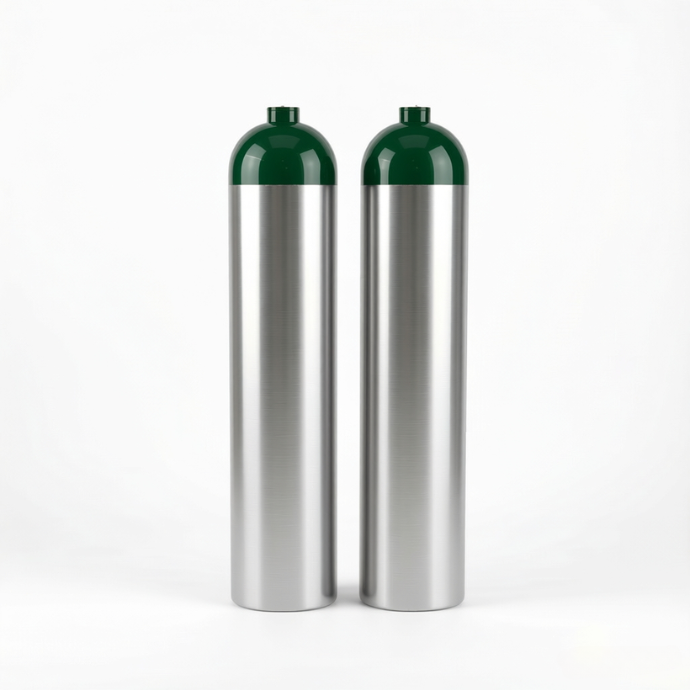
Hardware mismatch causes severe medical errors. The Compressed Gas Association (CGA) developed strict physical safeguards to prevent this. Small portable units use the Pin Index Safety System. Industry professionals call this the CGA 870 standard. You will find this valve on E-size units and smaller. The valve face features specific drill holes. Your regulator must have matching metal pins. This system prevents a user from accidentally attaching a nitrous oxide regulator to an oxygen supply.
Large stationary units abandon the pin system. Bulk tanks like the H-size use standard threaded connections. The industry refers to this as the CGA 540 standard. These valves require operators to screw a heavy-duty regulator directly onto the threaded nozzle. A CGA 540 valve accommodates much higher continuous flow demands. You cannot cross-connect a CGA 870 regulator to a CGA 540 valve. This hard separation simplifies facility safety audits.
Procurement teams must choose between two distinct material constructions. Your choice impacts worker safety and physical durability.
Aluminum Alloy (6061-T6): Manufacturers build almost all modern portable units from this alloy. It resists rust completely. It weighs significantly less than traditional metals. Paramedics prefer aluminum for mobility. However, aluminum feels softer. It remains highly susceptible to structural damage. Dropping an aluminum unit can shear the valve entirely.
Steel / Chrome-Moly: Facilities use steel exclusively for bulk storage. Steel handles higher pressure tolerances safely. It withstands massive physical impacts. The heavy weight anchors the tank securely in manifolds. Conversely, steel carries severe rust risks. Improper storage in damp basements degrades the vessel quickly.
You must verify regulatory compliance before issuing purchase orders. The Department of Transportation (DOT) governs the manufacturing process. They control the legal transport of any pressurized vessel across highways. The International Organization for Standardization (ISO) provides global design parameters. High-quality manufacturers stamp both DOT and ISO certifications directly onto the metal crown. Buying non-compliant hardware invites heavy fines and extreme legal liability.
Every pressurized vessel undergoes material fatigue. Regulators mandate strict hydrostatic testing intervals to catch micro-fractures. Standard aluminum vessels require professional testing every five years. Specialized models sometimes qualify for ten-year intervals. A stamped star symbol denotes this extended lifecycle. Buyers must account for testing downtime. Sending twenty tanks out for certification removes them from your functional inventory. You must procure extra buffer stock to survive this downtime.
Global suppliers use color-coding to identify medical gases instantly. However, regional standards conflict frequently. The US FDA standard mandates a green shoulder for oxygen. European and ISO standards mandate a white shoulder. Procurement errors occur when buyers source cheap gray-market equipment globally. Mixing color standards confuses clinical staff during emergencies. You should strictly enforce your region's color-coding rules during the vendor selection phase.
Proper storage prevents catastrophic facility damage. You must store all pressurized vessels perfectly upright. Secure them against a wall using heavy-duty chains or brackets. Never leave them freestanding in busy corridors. You must avoid combustible contaminant exposure. Keep oil, grease, and alcohol-based sanitizers away from the valves. Pure oxygen violently accelerates combustion when exposed to basic petroleum residues.
You need to evaluate your building's existing infrastructure. Consider how your staff replenishes empty supplies. Large hospitals manage bulk H-cylinders easily. They connect these giants to on-site refilling stations or central piping. Smaller clinics lack this heavy infrastructure. Ambulatory centers should rely on a vendor swap program. The supplier delivers full D or E units weekly and hauls away the empties. Map your delivery logistics before selecting a form factor.
We strongly recommend minimizing the variety of tank sizes in your fleet. Do not buy M4, M6, C, D, and E models simultaneously. This fragmentation creates logistical chaos. Staff will struggle to find the correct carrying bags. Regulator mismatch will delay patient care. Standardize your entire portable fleet on just two sizes. Many facilities choose the D model for transport and the E model for crash carts. Standardization simplifies staff training immensely.
Advise your procurement team to pause before requesting vendor quotes. Conduct a rigorous internal audit first. You must gather current flow-rate data from your respiratory therapy department. Count your existing CGA 870 and CGA 540 regulators. Evaluate their physical condition. Once you understand your true daily consumption and hardware limits, you can approach suppliers confidently. This preparation prevents you from buying incompatible or undersized equipment.
Choosing the optimal medical gas storage solution requires diligent research. You must align technical specifications like internal volume, valve type, and material construction with clinical reality. Continuous flow rates and daily transport needs dictate your ideal form factor. An improperly sized unit compromises patient safety during transfers.
A well-optimized cylinder fleet provides tremendous operational stability. It minimizes emergency stock-outs during critical surges. It reduces staff handling injuries by avoiding unnecessarily heavy steel tanks in portable scenarios. Most importantly, it ensures your facility maintains strict regulatory compliance across the board.
Take proactive measures today. Consult with a certified medical gas supplier in your region. Ask them to conduct a comprehensive facility-wide inventory and usage audit. Their data will guide your next major procurement cycle.
A: A standard D-size cylinder holds roughly 425 liters. You must subtract a safe residual limit of 200 psi before calculating. We apply the standard duration formula. Factoring in this safety buffer, you have enough volume for a steady supply. At a continuous flow rate of 2 LPM, the cylinder will last approximately 170 to 200 minutes. Always monitor the gauge closely.
A: The core difference involves capacity and physical weight. An M6 unit holds roughly 164 liters of gas. An M9 unit increases that capacity to approximately 255 liters. The M9 stands slightly taller and weighs more. Patients love the M6 for its ultra-lightweight portability. EMS teams typically choose the M9. It provides longer therapy durations without adopting the bulk of a standard D-size tank.
A: No. You cannot mix regulators safely. Portable tanks utilize the Pin Index Safety System (CGA 870). Large stationary tanks use threaded connections (CGA 540). This strict hardware separation prevents fatal medical gas mix-ups. Attempting to force the wrong regulator causes severe equipment damage. You must audit your facility’s regulator inventory before buying new tanks.
A: The Department of Transportation mandates regular hydrostatic testing. Most standard aluminum models require testing every five years. Specific specialty models qualify for a 10-year testing cycle. A unique star stamp on the metal shoulder marks these 10-year units. You must inspect the stamped date regularly. Remove any expired units from patient service immediately.

